 Holy Trinity Church
Advent
Hello, dear family of Holy Trinity Church,
This Sunday, the Catholic Church celebrates the First Sunday of Advent, marking the beginning of a new liturgical year. This liturgical season is a time of spiritual preparation, reflection, and anticipation as we prepare to celebrate the birth of Jesus at Christmas and ready ourselves for the Second Coming of Christ (the Parousia).
The word Advent comes from the Latin term adventus, meaning “coming” or “arrival.” Although this liturgical season spans four Sundays, its total duration varies because it concludes on Christmas Eve, December 24. Consequently, Advent can last anywhere from 22 to 28 days. In 2026, for instance, it will last 26 days, from November 29 to December 24.
During this season, we encounter several symbols that help us prepare for these two celebrations: Christmas and the Parousia.
1. The Advent Wreath
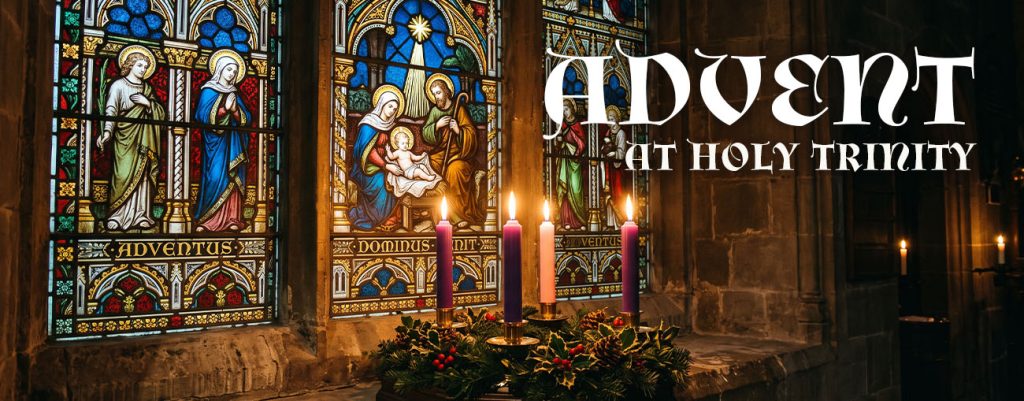
The Advent wreath is a circular arrangement of evergreen branches featuring four candles, typically three purple and one rose-colored. The circular shape is often understood to represent God’s eternal love, which has no beginning and no end. The evergreen branches, often made of pine or fir, symbolize new life, hope, and the eternal nature of Christ.
The candles are lit gradually, one each week, signifying that Christ, the Light of the World, is drawing near. Each candle is traditionally associated with a particular theme: the first purple candle represents hope; the second purple candle, peace; the third, rose-colored candle, joy; and the fourth purple candle, love. The Third Sunday of Advent is known as Gaudete Sunday, a day of rejoicing as we draw closer to Christmas. Some Advent wreaths also include an optional fifth, white candle, known as the “Christ candle,” which is lit on Christmas.
2. The Liturgical Color: Purple
The liturgical color for Advent is purple, or violet. This color carries several meanings, including a spirit of vigilance as we are called to remain watchful in anticipation of the Lord’s Second Coming. In the Gospel, Jesus reminds us—a message we will hear frequently during this liturgical season—that we do not know the day or the hour when the Son of Man will return.
Since the time of the Apostles and the early Christians, the Church has lived in expectation of the Lord’s Second Coming. The color purple also signifies a time of conversion and spiritual preparation as we ready ourselves for the Lord’s coming. For this reason, the Church also uses this color during Lent, a season that calls us to ongoing conversion and a deeper relationship with God.
3. The Sacrament of Reconciliation
The Sacrament of Reconciliation holds great importance during this liturgical season. The Catholic Church encourages us to receive this sacrament as a way to cleanse our hearts and prepare our souls to celebrate the birth of Jesus at Christmas. Many parishes offer special opportunities to receive the Sacrament of Confession during Advent.
Let us make a thorough examination of conscience and take advantage of this beautiful sacrament, which restores our friendship with God and reminds us of His infinite love and mercy.
My brothers and sisters, let us live this Advent season with faith and joy. Let us prepare not only our homes—with garlands, Christmas trees, and Nativity scenes—but also our hearts through the spiritual practices of Advent. May we open our hearts to Christ and allow Him to come and dwell within us.
Remember, The Parish that we dream is the Parish that I help to build!
God Bless you, and may the Blessed Virgin Mary be with you always!
Fr. Jorge Ramirez
Holy Trinity Church… 165 years evangelizing!


